Agar-induced hollow porous carbon nanospheres anchored platinum for high-performance hydrogenation
Cai, BF (Cai, Bingfeng)[ 1 ] ; Li, ZJ (Li, Zhijuan)[ 1 ] ; Zhang, ZB (Zhang, Zhenbo)[ 1 ] ; Zhang, XB (Zhang, Xuebin)[ 1 ] ; Tang, YW (Tang, Yawen)[ 1 ]*(唐亚文); Bao, JC (Bao, Jianchun)[ 1 ]*(包建春)
[ 1 ] Nanjing Normal Univ, Jiangsu Collaborat Innovat Ctr Biomed Funct Mat, Sch Chem & Mat Sci, Jiangsu Key Lab New Power Batteries, Nanjing 210023, Peoples R China
CHEMOSPHERE,202003,243
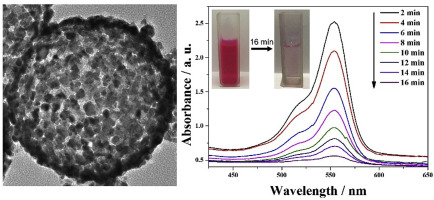
Hollow porous carbon has attracted a great deal of interest as catalyst-support because of its high surface area, low density and large pore volume. Herein, we develop a layer-by-layer assembly method to effectively load Pt nanoparticles on hollow porous carbon nanospheres (Pt/HPC) through using modified-SiO2 nanospheres as the template and agar as the carbon resource. The gel properties of agar (e.g., sensitivity to temperature and high mechanical strength) makes the Pt nanoparticles well crosslink with carbon, as well as endows the carbon nanospheres with robust stability. The synthesized Pt/HPC was employed as a catalyst in the hydrogenation reduction of rhodamine B (RhB). The catalytic results demonstrate that Pt/HPC is very promising for RhB hydrogenation as compared to commercial Pt/C catalyst. It is proven that such excellent activity of Pt/HPC can be attributed to the combined merits of hollow porous architecture and well combination between HPC and Pt nanoparticles.
文章链接:
https://www.sciencedirect.com/science/article/pii/S004565351932627X?via%3Dihub